1) La bataille
meutrière du
Mont Saint Jean
Salival
est
situé au nord du Mont Saint Jean.
Trois jours de bataille furent nécessaire aux
Américains,
en novembre 1944, pour s'emparer de la côte Saint Jean
défendue
par les Allemands et qui constituait le verrou de la Seille.
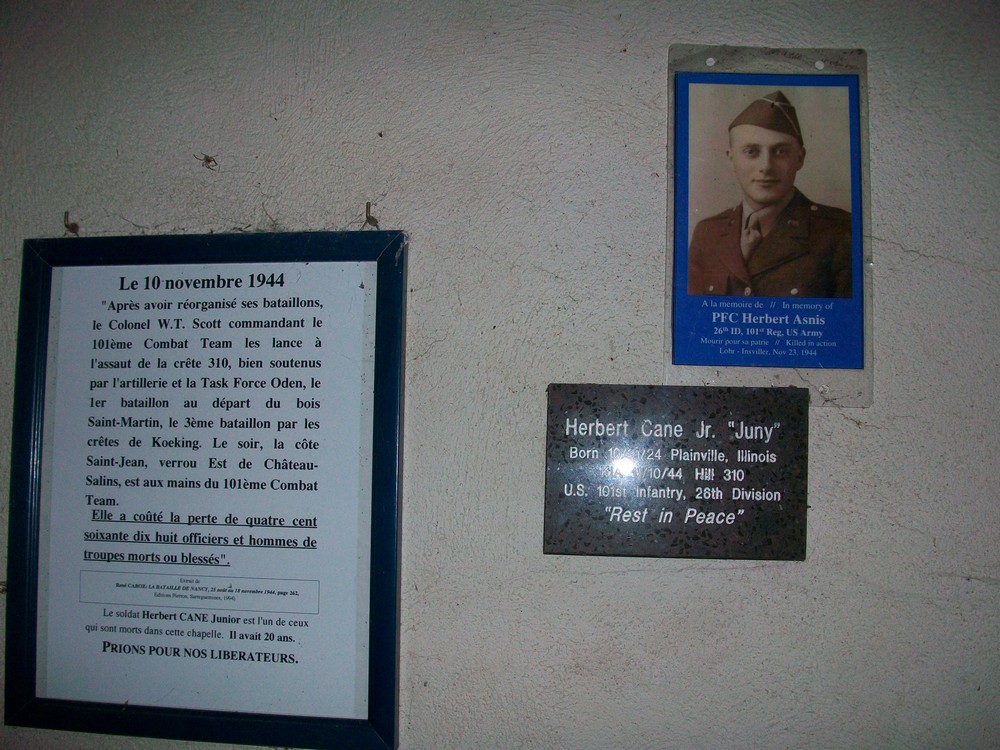 |
| Plaque commémorative située dans la chapelle Saint Livier |
On déplora plus de quatre cents morts et blessés
du
côté américain et au moins autant du
côté allemand. Ceux-ci furent enterrés
au
cimetière allemand de Niederbronn, les américains
quant
à eux le furent au cimetière de Saint Avold.
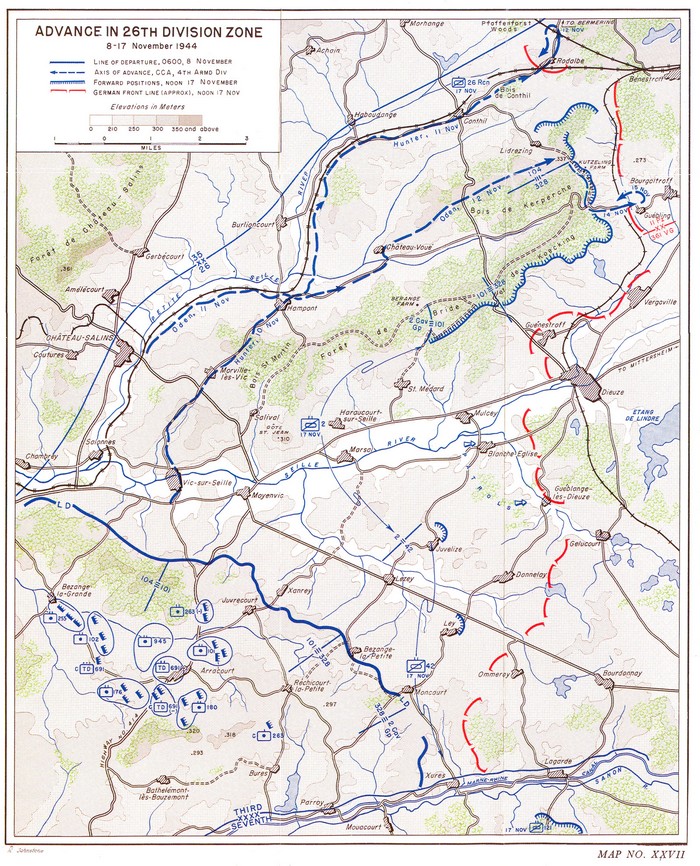
Pour les anglophones, voici trois récits de la bataille de
la
côte Saint Jean:
récit n°1:
101st
Infantry Regiment
Battle Honors
"The
plan was for the 3rd Battalion to follow the 2nd Battalion when it had
reached Moyenvic, France, at which time the 1st Battalion was to
disengage itself from the enemy and assemble in the vicinity of
Juvrecourt, France, and follow the 3rd Battalion around the left of the
position and thence to Moyenvic. "Hill 310" was the initial objective.
In the darkness of the
morning of
November 8th, Lt. Col. Lyons left to join the forward elements of his
Battalion. With no indications that the enemy suspected an attack, Lt.
Col. Lyons inched the assault echelons of his Battalion closer to the
enemy lines for a better jump-off position. At 0600 on the 8th November
1944, the attack jumped off, preceded by a thoroughly devastating hour
of artillery preparation.
For many men in the
Regiment the
deafening, ceaseless, foreboding roar of artillery on this morning
marked a standard by which future mornings could and would be judged.
Moving in a column of battalions, 2nd Battalion leading, the assault on
Hill 310 had started. A surprise jump-off found "G" Company in
Moyenvic, France, and "I"
Company in Salival,
France, before the enemy could catch his breath. "E" and "F" Companies
continued around the flanks of Moyenvic, establishing a river crossing
by swimming the Seille River and capturing a bridge north of Moyenvic.
An important stepping stone, this bridge assisted both companies in a
continuous drive on to the hill, elements of "F" Company having made
for the hill prior to the capture of the bridge. At 0915 elements of
"E" and "F" Companies were securely entrenched on the high ground of
Hill 310, when later they were reinforced by "L" Company and "M"
Company. The 1st Battalion had effected a convincing demonstration in
its original position so that the enemy would not discover the line of
thrust of the Regiment's main effort. At 1100 the 1st Battalion
extracted itself from the enemy, followed the route taken by the other
two battalions, and contacted "I" Company on the west side of Hill 310.
The drive was made not
without
difficulty. The attack had carried the Division into a penetration of
the enemy's lines, leaving elements of the enemy on the Regiment's
right rear. A terrific stream of enemy harassing artillery fire came
from that enemy element, conservatively estimated at 3500 rounds in a
period of two days. Moreover, Hill 310 was the beginning of a ridgeline
which ran to the north and then turned to the east, affording the enemy
direct observation on Hill 310 and the surrounding area. "
récit
n°2:
“Time
on
Target: The 945th Field Artillery Battalion in World War II”
(Hardcover)
The Lorraine Campaign
3 September to
16 December 1944
-
"All
the
eastern sky glowed and trembled with the flashes of guns"
- Maj. Gen. Patton
Hill 310 ou
côte saint Jean
"The 104th Infantry
(26th Inf. Div.)
advanced into Vic-Sur-Seille, and the 101st Infantry seized a bridge at
Moyenvic; however, Hill 310 just east of Vic-Sur-Seille remained in
German hands. The deterioration in the weather prevented artillery
support, and the men on the hill, many of whom had shed their coats in
the initial attack on the first day, suffered from exposure when rain
and snow began to fall late on the 8th and into the next two days. It
would take three days of fighting in the cold and snow to take the
hill, with a cost of 478 officers and men killed or wounded. The 945th
was again close to the front with all three batteries around
Vic-Sur-Seille on 10 November.
At the end of the first
day all of the
units for the 35th, 80th and 26th Infantry Divisions were at their
assigned objectives - then the rain started. The 945th fired 435 HE
rounds to support the attack. The War Diary notes that the 8th started
clear, turning to rain in the afternoon. By the next day it was snowing.
récit
n°3:
- Artillery
And Armored Units In The ETO
For
its entry into combat on 8 November at
Athainville east
of Nancy, parts of the battalion, as was normal for separate armored
units, were attached to elements of the 26th Division and placed in
special task forces. The 26th Division was then preparing for XII
Corps' November offensive.
Company A of the 761st was attached to the 104th Infantry with one
platoon attached to the 101st Infantry. Company C was attached to the
328th Infantry. Provisional Task Force A contained Company K of the
101st Infantry, engineers, the 602d Tank Destroyer Battalion (-), and
the remainder of the 761st Tank Battalion (excepting its mortar,
assault gun, and reconnaissance platoons, in reserve) , all under the
command of Lt. Col. Peter J. Kopcsak, commander of the 602d Tank
Destroyer Battalion.
On
the first day, Company A's two platoons supported the 104th Infantry's
attack and capture of Vic-sur-Seine; the remaining platoon of Company A
supported infantry in taking Moyenvic. Company C, attached to the 328th
Infantry, used its twelve tanks in the assault on Bezange-la-Petite and
a hill to the southeast. On 9 November, in the season's first
snowstorm, the two platoons of Company A supported the 104th Infantry,
which attacked and took Chateau-Salins after four hours of fighting.
Company A then turned east toward Morville-les-Vic. The remainder of
the battalion in Task Force
A,
with infantry mounted on its tanks, was then approaching Morville. Two
platoons of Company D, with two companies of the 3d Battalion, 101st
Infantry, took positions south of Salival,
a small town from which enemy machine gun fire enfiladed the western
slope of Hill
310 (Cote St. Jean) , the
26th Division's main objective for the day. Company D shelled the town
and set it afire. Infantry, at dusk, entered Salival and passed through
the woods beyond.
At
Morville-les-Vic, where heavy enemy mortar and artillery fire was
encountered, tanks of Company B shelled the town. When they attempted
to pass through, roadblocks and bazooka fire stopped the tanks. The
lead tank, knocked out, blocked the narrow main road, halting the tank
column. Infantry cleared the town in house-to-house fighting. In the
meantime, Company C seized high ground to the northwest of Morville and
held until infantry took over, while Company D, moving to the left
flank from Salival to screen the attack,
broke up a German counterattack. Company C, moving down from its high
ground toward Morville, ran into a tank trap running from woods at the
edge of the high ground to a road leading through Morville. Beyond the
tank ditch were camouflaged pill boxes, by now further concealed by
new-fallen snow. Company C lost nine enlisted men and one officer
killed and seven tanks-four recoverable-in the action along the tank
trap. Despite low visibility caused by the weather, the battalion's
assault gun platoon, aided by the observations of artillery liaison
planes, completed its firing missions, securing direct hits on an enemy
armored vehicle and four trucks. Task Force A, finally getting seven
tanks through Morville, went on toward Hampont, the tanks assisting the
infantry in gaining a foothold in the Bois de Geline to the northeast.
Première
Page
Page
Précédente
Page
Suivante Dernière
Page